Here’s another fully rewritten version with a more concise, news-style tone:
Bitcoin Drops Into Fire-Sale Zone as Long-Term Holders Take $2.4B Hit
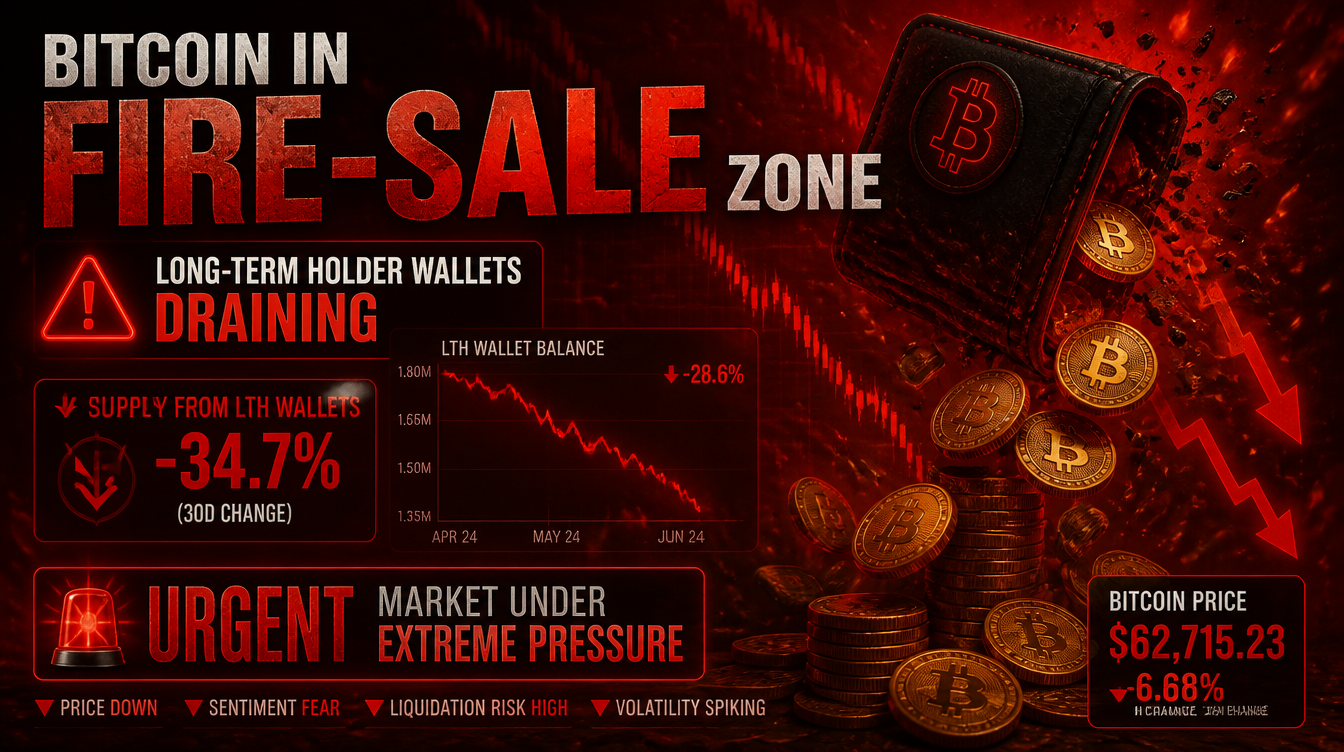
Bitcoin has slipped into a “fire-sale” phase after long-term holders realized roughly $2.4 billion in losses over a 48-hour period ending June 5, 2026. The decline pushed price below the Short-Term Holder Realized Price (STH-RP), a key on-chain support level often seen as the last safeguard in a bull market.
The move comes amid a broader risk-off environment across global markets, with more than $2 billion in long liquidations across derivatives and the Fear and Greed Index plunging to 12/100—levels associated with extreme panic, last seen during the COVID-19 crash and the 2022 FTX collapse.
At this stage, the debate is no longer about whether the downturn is significant, but whether current long-term holder behavior signals a deeper cycle shift or a temporary capitulation that could precede recovery.
On-Chain Data Points to Capitulation
Market data shows heavy selling pressure, with the Long-Term Holder SOPR (LTH-SOPR) falling below 1.0—indicating that coins held for more than 155 days are being sold at a loss.
This pattern is rare during bull markets and has historically aligned with major market bottoms, including those in 2015, 2018, and 2022. Recent figures suggest that about 26% of sold Bitcoin came from holders who bought above $90,000, signaling a transition from accumulation to distribution.
CryptoQuant describes this phase as an on-chain capitulation event. The STH-RP metric suggests Bitcoin is trading at deep discounts, firmly within a “fire-sale” range. While this environment may attract buyers seeking value, similar periods in the past have lasted for weeks or even months before a clear bottom formed.
Bitcoin is currently down around 30–35% from its peak—historically enough to flush out late entrants without necessarily ending the broader uptrend. However, whether this is a correction or a cycle top remains uncertain.
Additional Indicators Show Pressure, Not Confirmation
Other on-chain signals support the capitulation narrative but do not confirm a bottom. The MVRV Z-Score is currently near -1.5, aligning with the $62,000–$65,000 range—a zone that has previously acted as strong support and accumulation.
A large share of Bitcoin supply is now held at a loss, similar to late-2022 conditions, but this alone does not indicate that selling pressure has fully eased.
Meanwhile, the Realized Cap HODL Wave shows increased activity among coins aged 1–3 months, while older holdings remain relatively stable—suggesting the market has not yet reached deeper bear market conditions.
A confirmed bottom would require reduced selling from long-term holders, a sustained move back above the STH-RP, and stabilization in loss-held supply—none of which are clearly visible yet.
Outlook: Three Potential Paths
Bullish Scenario:
Bitcoin regains the STH-RP level within the next 5–10 days, supported by ETF inflows and reduced selling pressure. Holding the $62,000–$65,000 range could signal accumulation, with upside targets between $85,000 and $92,000 over the next few months.
Neutral Scenario:
Price consolidates between $60,000 and $68,000 for several weeks as long-term holders complete distribution. Indicators would include declining realized losses and steady capital inflows without sharp price moves.
Bearish Scenario:
A break below $60,000 could trigger another wave of selling, potentially pushing Bitcoin down to $52,000–$55,000—a correction of up to 50%. Warning signs would include continued ETF outflows, worsening sentiment, and further declines in LTH-SOPR.
The key signal to watch is whether losses from long-term holders begin to shrink. A slowdown would suggest selling pressure is fading, while continued losses would indicate ongoing capitulation.