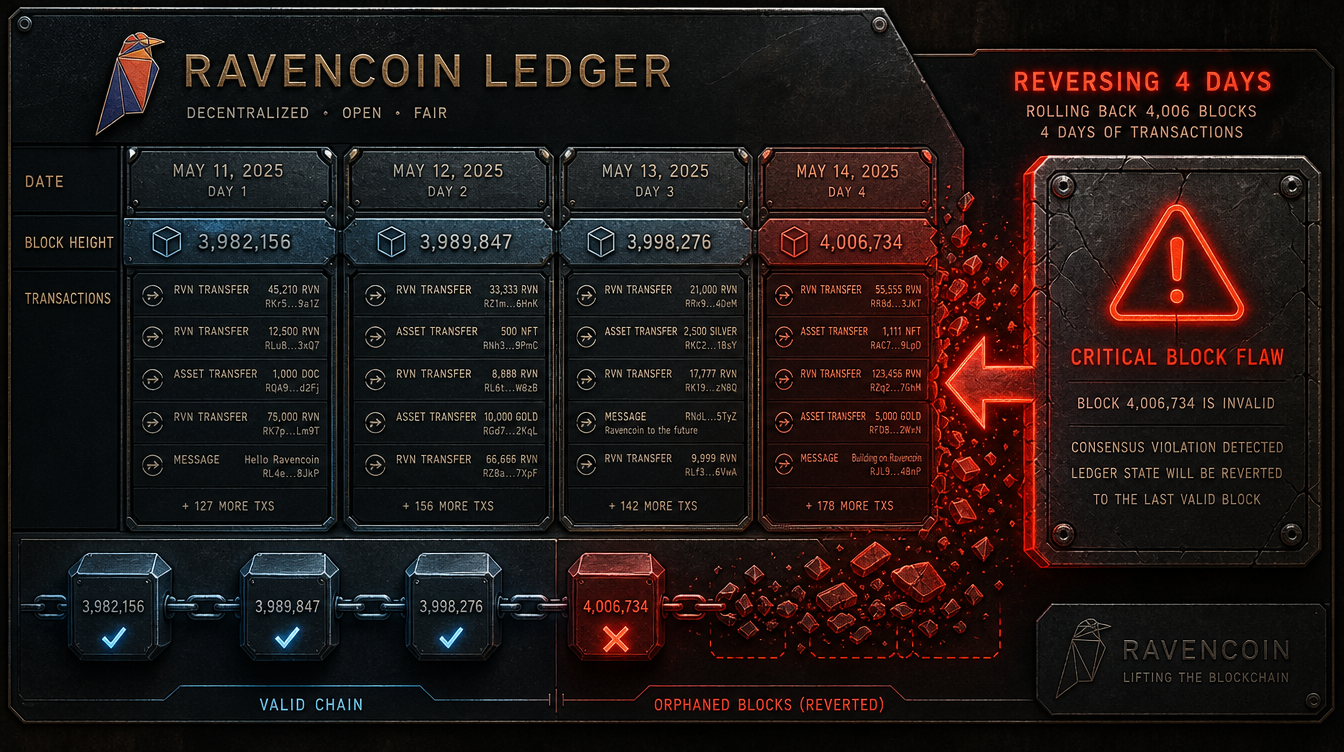
Ravencoin is facing the possibility of a multi-day blockchain rollback after two mining pools with most of the network’s computing power began rebuilding the chain from before Friday’s first invalid block. If their version becomes the accepted chain, deposits, withdrawals and payments recorded afterward could be wiped from the ledger.
The Ravencoin team said Tuesday that a critical software vulnerability had been exploited, allowing attackers to generate invalid blocks and putting several days of transaction history at risk.
Ravencoin launched in 2018 as a Bitcoin-derived blockchain focused on issuing and transferring digital assets. It uses a mining-based consensus system similar to Bitcoin, but its much smaller network makes it more vulnerable to influence from a limited number of mining pools when competing versions of the chain emerge.
That concentration is now playing a central role. 2Miners and RavenMiner collectively control most of Ravencoin’s hashpower and are rebuilding the blockchain from block 4,487,775, the last block produced before the exploit. If sufficient mining power backs the rebuilt version, transactions added after that block could be replaced by the older history.
Blockchains record transactions in batches known as blocks. Miners use computing resources to compete for the right to add new blocks, while most individual miners participate through pools that combine their hashpower and divide the rewards. The chain supported by the greatest computing power is generally treated as the valid network history.
For users, a rollback could mean that completed transactions are effectively undone. An RVN payment that appeared successful could disappear from the ledger, returning the coins to the sender while leaving the recipient without the expected funds.
The risk also extends to exchanges and other platforms that rely on blockchain deposits. An exchange could credit a customer after receiving RVN and allow the funds to be withdrawn, only to find that the original deposit disappears following a rollback. Several trading platforms have therefore restricted RVN activity.
Bitvavo suspended both Ravencoin deposits and withdrawals after the vulnerability was exploited. South Korea’s Upbit issued an investment warning for RVN across its KRW, BTC and USDT markets and also halted deposits.
Ravencoin exploit timeline
The first invalid block was mined at height 4,487,776 at 15:44 UTC on Aug. 7. After the vulnerability was exposed on the live network, other attackers reportedly began using the same weakness to create additional invalid blocks.
Ravencoin has released a software update to address the vulnerability. However, deploying a fix prevents further exploitation but does not automatically reverse blocks that have already been added to the chain.
The two dominant mining pools are rebuilding the network from block 4,487,775, immediately before the first invalid block. Ravencoin said it asked both pools to choose a more recent restart point to limit the amount of history that could be affected, but the request was not accepted.
RavenMiner said its infrastructure has already been updated with an emergency patch and that it is mining what it considers the clean version of the chain. The pool said blocks created during the exploit window are being rejected across the network, meaning mining rewards from that period would be rolled back for miners generally rather than only for RavenMiner customers.
RavenMiner has paused payouts while the chain dispute is resolved and said it would cover any resulting losses itself. It also stated that mining rewards earned before 15:44 UTC on Aug. 7 are not affected.
This is not the first major security incident to hit Ravencoin. In 2020, a separate vulnerability allowed attackers to generate RVN beyond the cryptocurrency’s intended supply rules. Roughly 31 million additional tokens were created before the issue was patched.
RVN has also suffered a sharp market reaction. The token dropped about 17% over 24 hours to approximately $0.0029, putting its market capitalization near $48 million. Trading volume was around $10 million, while RVN remains approximately 77% below its level from a year ago.