Bitcoin is trading near $61,100, falling about 3% in the past 24 hours and roughly 6.9% over the week as a stronger-than-expected May jobs report pushed up expectations for higher-for-longer interest rates, triggering a broad risk-off move across financial markets.
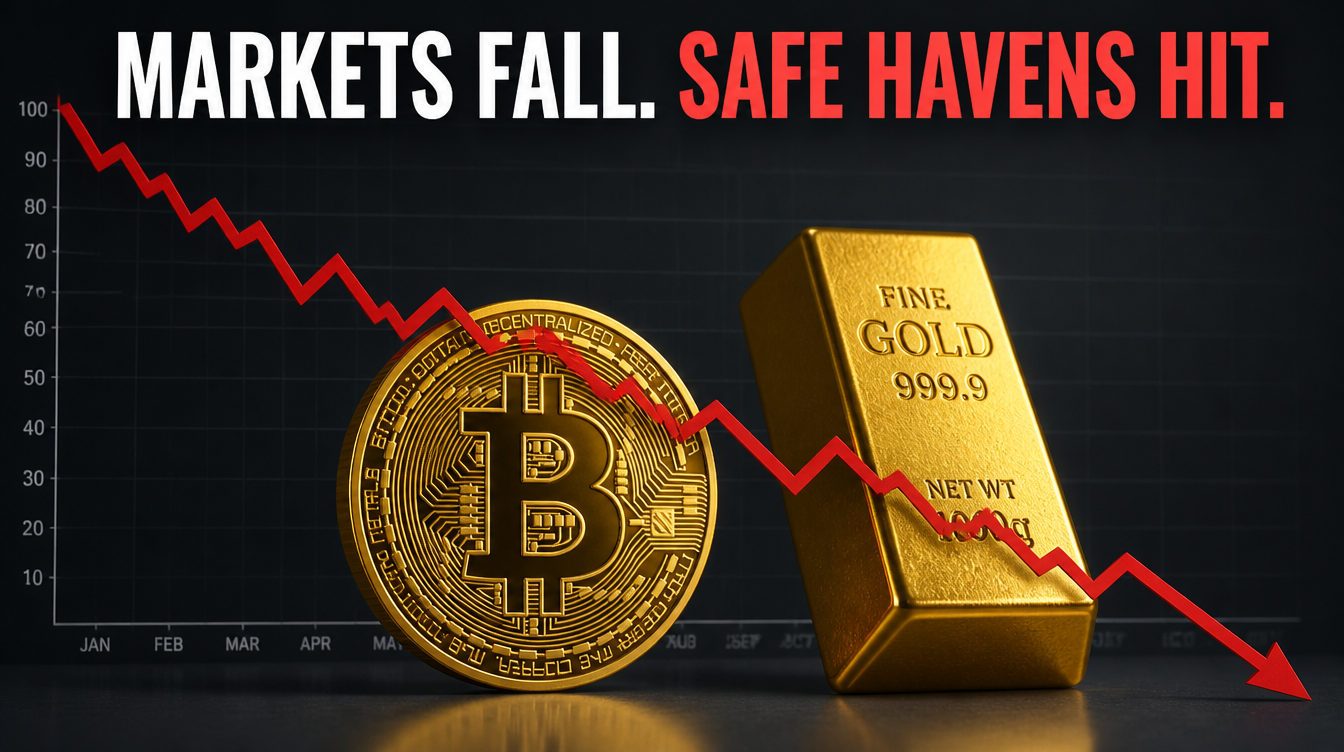
Gold also declined, slipping around 2% to below $4,200 per ounce. Both assets moved lower in tandem, contradicting the common view that they typically diverge during macro stress.
The trigger was the U.S. labor data: 172,000 non-farm payrolls in May versus expectations of 130,000, while April’s figure was revised higher to 214,000.
This stronger labor picture reinforced expectations that Fed rate cuts will be delayed well into 2027, forcing a broad repricing of liquidity conditions that had supported crypto, equities, and gold through late 2025.
Bitcoin News: Are Safe-Haven Narratives Breaking Down?
The transmission mechanism is clear: stronger economic data reduces the need for monetary easing, pushes real yields higher, strengthens the U.S. dollar, and reduces demand for non-yielding assets.
Both Bitcoin and gold fall into that category. When interest rates rise or stay elevated, institutional investors are less incentivized to hold assets that do not generate yield.
The 10-year Treasury yield climbed to 4.54%, while Brent crude rose near $92 per barrel, adding further inflation pressure and complicating the Federal Reserve’s policy outlook.
New Federal Reserve Chair Kevin Warsh now faces a critical decision at the June 17–18 FOMC meeting: maintain policy with a cautious tone or tighten further to reinforce inflation control.
Cleveland Fed President Beth Hammack has already suggested the Fed may need to act soon, while Wall Street Journal reporter Nick Timiraos noted that the stronger labor market has effectively removed expectations for near-term rate cuts.
At the same time, Bitcoin ETF outflows have continued to accelerate. According to sFOX executive Diana Pires, while dip buyers have appeared opportunistically, sustained spot demand has yet to return.
Persistent outflows from U.S. spot Bitcoin ETFs, combined with Strategy’s first BTC sale since 2022, have weakened confidence in the idea of strong institutional dip-buying support that previously helped stabilize prices above $70,000.
Broader markets also reflect the stress. South Korea’s Kospi dropped 6.3%, the MSCI Asia-Pacific index fell 2.5% for its fourth decline in five sessions, and Nasdaq 100 futures slipped 0.8%.
More than $500 million in bearish positions were liquidated, the largest such event since April, suggesting the earlier bounce was driven by short covering rather than new spot demand. Bitcoin’s brief move toward $62,500 failed to attract enough sustained buying to maintain momentum.
Correlation Stress Between Bitcoin and Gold
The relationship between Bitcoin and gold has become increasingly unstable. While 180-day rolling correlations have recently climbed toward 0.6, CryptoQuant data shows that correlations can swing as low as -0.88, highlighting how quickly macro conditions can invert their relationship.
If the June 17–18 FOMC delivers a pause with dovish guidance, oversold conditions could fuel a sharp relief rally. However, if Warsh signals tighter policy or hints at a hike, downside pressure could intensify further.
BTC Technical Outlook: Key Support Under Pressure
Bitcoin is currently trading around $61,146 and has broken below its February lows, which previously served as a key support zone. This marks its weakest level since mid-2024 and signals a clear breakdown in the short-term structure.
The $61,000–$62,000 region had been a critical support area for the recovery narrative. Losing it with strong downside momentum significantly weakens the technical outlook.
If current levels fail to hold, the next major support lies in the $55,000–$58,000 range, which corresponds to a prior accumulation zone from mid-2024.
While the speed of the decline raises the possibility of short-term relief bounces, such moves are likely to face selling pressure rather than sustained follow-through in the current environment.
To stabilize, Bitcoin would first need to reclaim the $64,000–$65,000 range. A stronger recovery would only begin if $68,000 is reclaimed as support.
At present, the market structure remains in breakdown mode, with sellers clearly in control and bulls needing to re-establish support before any meaningful recovery can develop.