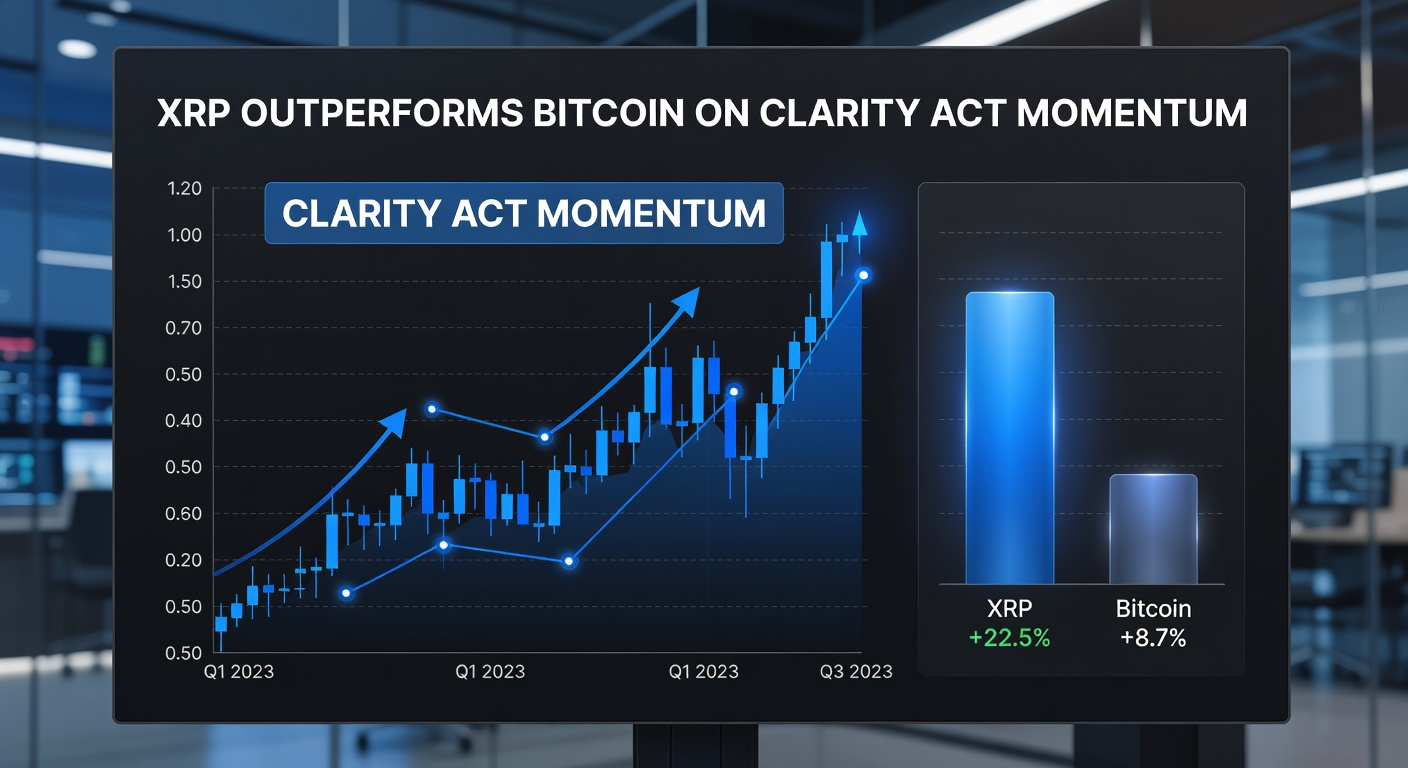
XRP climbed 5% after U.S. lawmakers advanced a key crypto market-structure bill, reigniting expectations that clearer regulation could unlock deeper institutional participation in the asset.
Traders got the long-awaited regulatory catalyst on Thursday as the Senate Banking Committee approved the Digital Asset Market Clarity Act in a 15–9 vote, pushing one of Washington’s most closely watched crypto bills closer to a full Senate debate.
Following the vote, XRP surged past $1.50, gaining 5% over 24 hours and 7.6% on the week—outpacing major tokens such as bitcoin and ether, which posted weekly gains of less than 3%.
The strong reaction reflects XRP’s unique exposure to U.S. regulatory developments. Since the SEC filed its lawsuit against Ripple in December 2020, the token has faced years of exchange delistings, institutional caution, and uncertainty over its legal status. While a 2023 ruling by Judge Analisa Torres clarified that secondary-market XRP trading does not constitute securities transactions, the market has continued to await comprehensive federal legislation.
The proposed CLARITY Act aims to establish a formal framework for digital asset markets, providing clearer rules around custody, trading, market making, and ETF allocations—key requirements for large institutional investors.
However, the legislative path remains complex. The Senate Banking version must still be reconciled with a separate Agriculture Committee draft, pass a full Senate vote, clear the House, and ultimately be signed into law. Senator Cynthia Lummis has indicated broad alignment on much of the bill, though Senator Elizabeth Warren has raised objections. The upcoming Memorial Day recess adds urgency to the process.
Beyond regulation, XRP’s momentum is also being supported by growing ecosystem activity and institutional engagement tied to Ripple.
Market participants point to structural developments within the XRP Ledger, which is increasingly being positioned as a compliance-ready infrastructure for tokenization and settlement. Industry voices argue that the network is evolving into a system aligned with institutional requirements, rather than purely speculative use cases.
Recent data underscores that trend. Tokenized real-world assets on the XRP Ledger have surpassed $3 billion, placing it among the leading non-Ethereum platforms for institutional tokenization. A recent pilot involving Ripple, JPMorgan, Mastercard, and Ondo Finance demonstrated near-instant settlement of tokenized U.S. Treasurys, highlighting the network’s ability to bridge blockchain infrastructure with traditional finance.
At the same time, the broader DeFi ecosystem linked to XRP has expanded, with total value locked exceeding $560 million across platforms such as Flare and Doppler Finance.
Institutional flows have also picked up. U.S.-listed spot XRP ETFs recorded $25.8 million in net inflows earlier this week—their strongest single-day intake since January—bringing cumulative inflows to $1.35 billion. The inflows followed Ripple’s $200 million debt raise for its Prime brokerage arm and continued progress in tokenization initiatives.
Despite the recent rally, XRP remains below its 2025 highs, with the $1.50 level acting as a key threshold for bullish momentum.
While the committee vote provided a near-term catalyst, markets continue to focus on the bigger picture: durable legal clarity at the federal level remains the critical driver for a sustained XRP breakout.