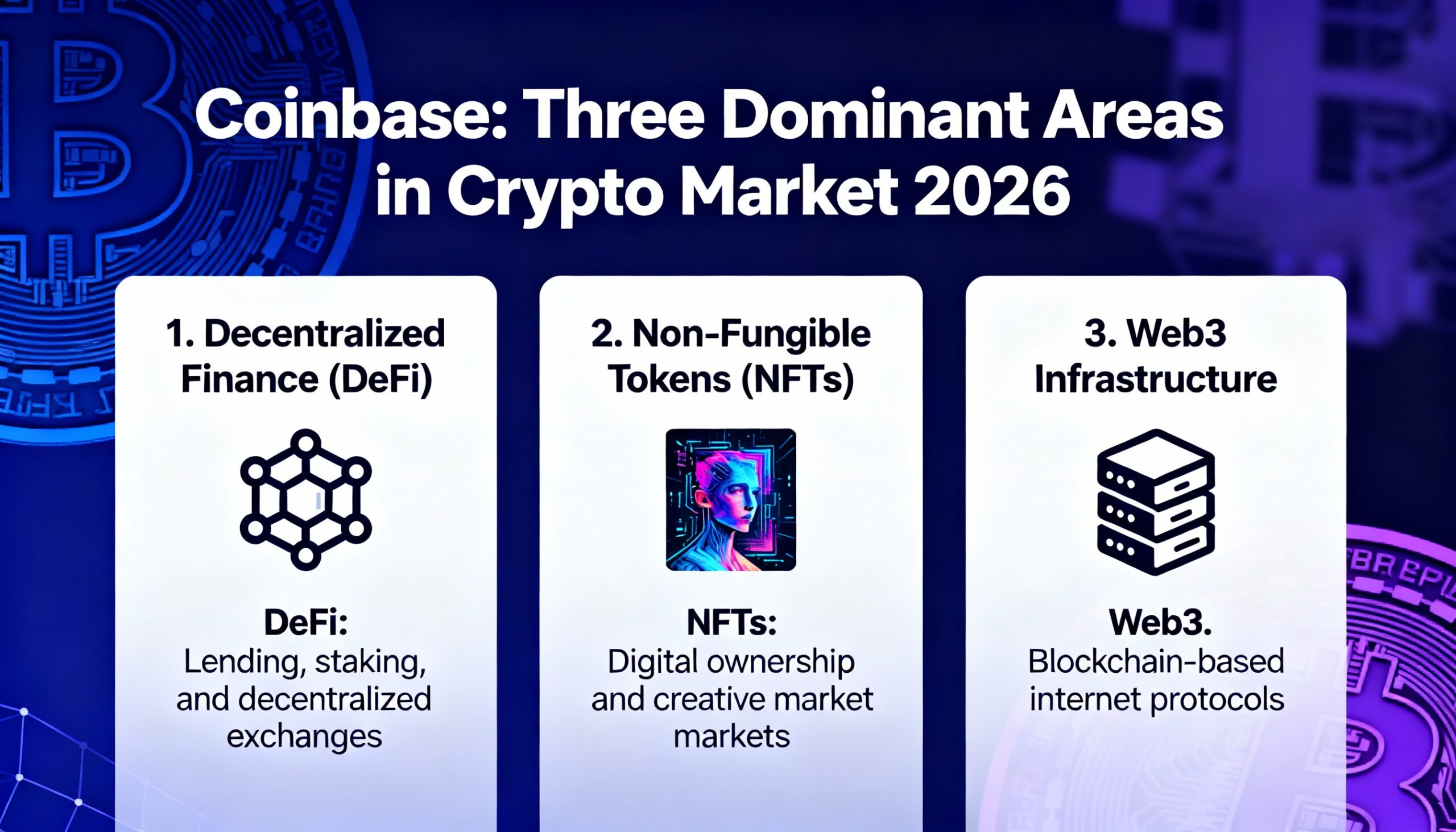
Coinbase Institutional says that shifting market structures, rather than hype-driven cycles, will define crypto trading and adoption in 2026, as activity increasingly concentrates in a few core areas.
According to a new outlook from the firm, 2026 will test whether crypto’s core markets can scale under more disciplined conditions, marking a shift away from retail-driven narratives toward structural fundamentals. The report, authored by global head of research David Duong and research associate Colin Basco, argues that traditional crypto cycle models—reliant on retail speculation, token launches, and protocol-specific catalysts—are becoming less predictive as institutional participation and market infrastructure play a larger role in price formation.
Perpetual futures are identified as a central pillar of crypto market activity. Derivatives now account for the majority of trading volume on major venues, shifting price mechanics toward positioning, funding rates, and liquidity conditions rather than retail momentum alone. Coinbase notes that leverage was sharply reduced after late-2025 liquidation events, describing the drawdown as a structural reset that removed speculative excess while preserving participation in perpetual futures. Improved margin practices and risk controls, the report argues, are creating markets that absorb shocks more efficiently.
Prediction markets are also evolving from experimental tools into durable financial infrastructure. Rising notional volumes and deeper liquidity indicate that these platforms are increasingly used for information discovery and risk transfer. Fragmentation across prediction markets is driving demand for aggregation, attracting sophisticated participants and broadening usage beyond crypto-native traders, particularly as regulatory clarity improves in select jurisdictions.
Stablecoins and payments remain another core growth area. Coinbase highlights that stablecoin transaction volumes continue to expand through settlement, cross-border transfers, and liquidity management rather than speculative trading. Payment activity is increasingly intertwined with other parts of the ecosystem, including automated trading and emerging AI-driven applications, which the firm views as reinforcing blockchain-based payments as foundational infrastructure rather than competitive pressure.
Coinbase concludes that 2026 will test whether these structural elements can continue to scale and manage risk under tighter conditions, with implications for the future of crypto that extend well beyond the next price cycle.