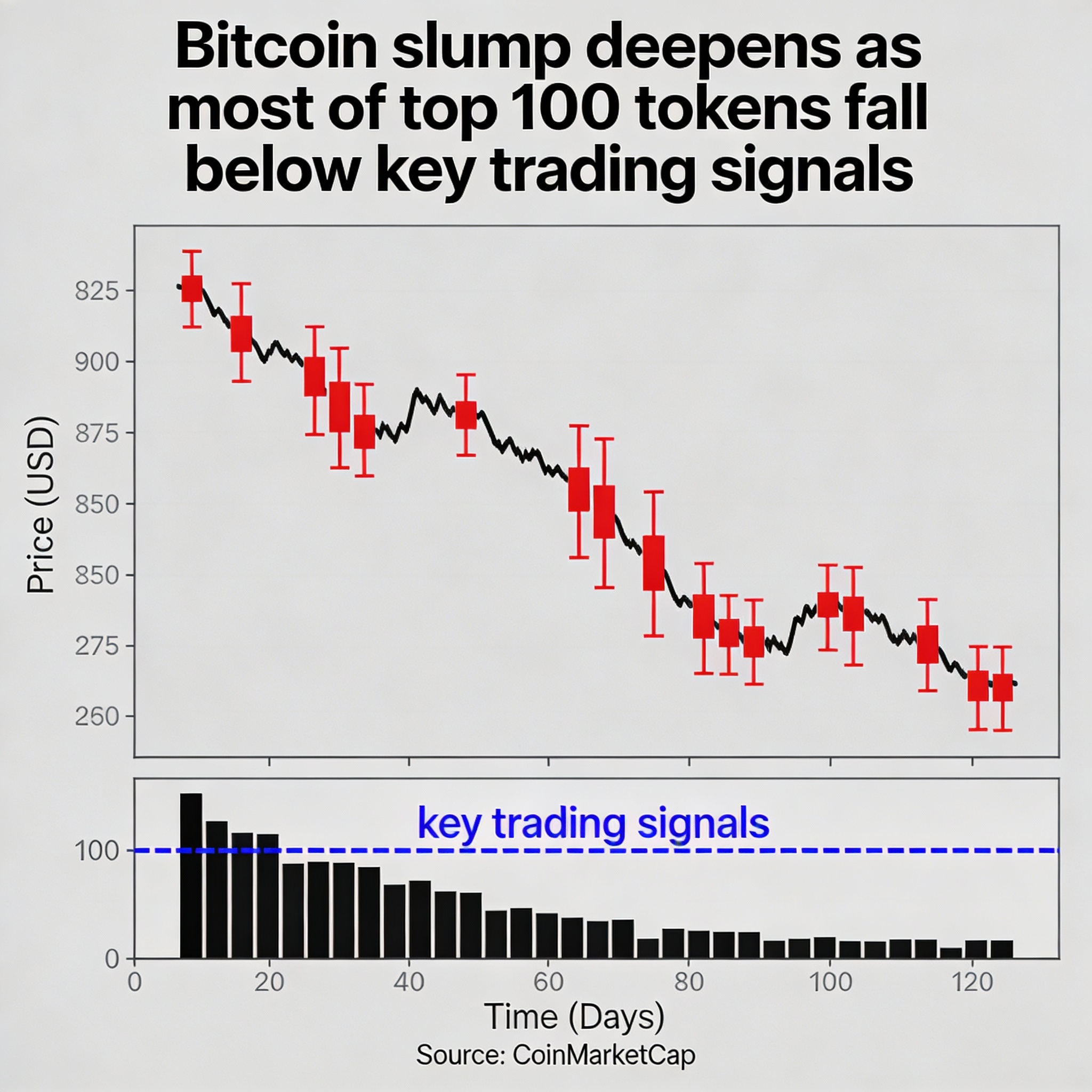
The largest single-day outflow since late January comes as bitcoin shows signs of stalling near a key technical level.
A major driver behind bitcoin’s recent rally above $80,000 appears to be losing momentum. The 11 U.S.-listed spot bitcoin exchange-traded funds (ETFs), which attracted $3.29 billion in inflows across March and April, are now seeing notable withdrawals.
On Wednesday alone, investors pulled $635 million from these funds—the biggest daily outflow since Jan. 29, according to SoSoValue data. The move is part of a broader trend, with total outflows reaching $1.26 billion over the past five trading sessions. As a result, cumulative net inflows since the ETFs launched in January 2024 have slipped to $58.5 billion, down from $59.76 billion just a week earlier.
At the same time, bitcoin’s upward momentum has faded. The rally from $65,000 to above $80,000 has stalled, with prices struggling to break above the 200-day simple moving average near $82,000. Over the past 24 hours, bitcoin has fallen more than 2% to around $79,400.
Analysts attribute the pullback largely to renewed inflation concerns in the U.S., even as traditional markets remain resilient. Both the Nasdaq and S&P 500 reached fresh highs on Wednesday, suggesting crypto may be reacting more sensitively to macro pressures.
The scale of the $635 million outflow is difficult for bullish investors to ignore, particularly given that strong ETF inflows in recent months were widely viewed as a key catalyst for bitcoin’s rally. Meanwhile, the macro backdrop is becoming less supportive, with inflation risks on the rise.
“A persistently elevated CPI, a more hawkish Federal Reserve outlook, or another oil price shock could weigh on bitcoin even if ETF flows remain positive,” said Adam Haeems, head of asset management at Tesseract Group. “The more important question is whether macro conditions stay accommodative enough for capital flows to continue supporting prices.”
Still, the relationship between ETF flows and bitcoin’s price action appears to be weakening. Data shows that the 90-day rolling correlation between bitcoin’s daily returns and changes in cumulative ETF inflows has dropped to just 0.16—effectively negligible—down from 0.68 in February.
In practical terms, this suggests that daily ETF flow direction no longer provides a reliable signal for short-term price movements. However, large outflows like Wednesday’s still carry weight, particularly when they coincide with fading momentum and a shifting macro environment.