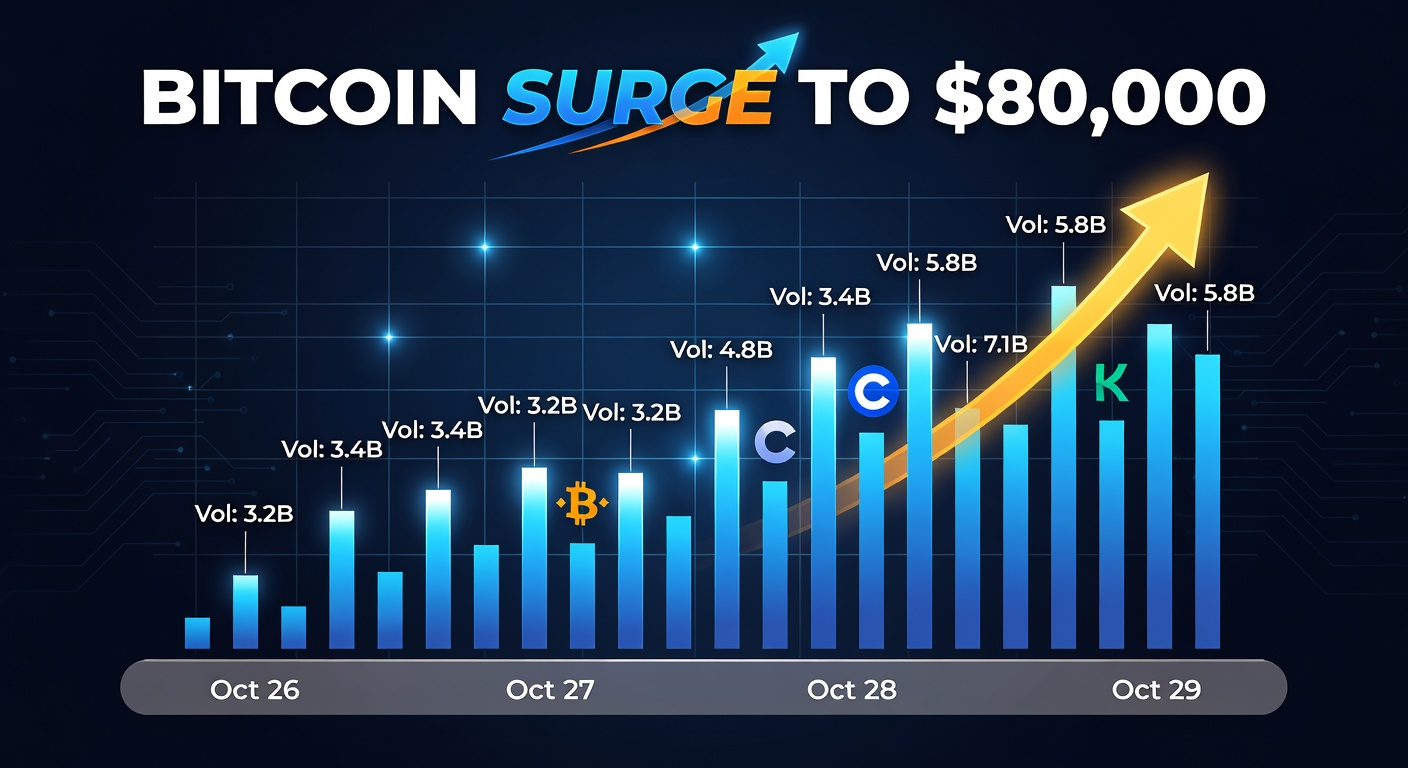
Bitcoin’s recent push above $80,000 appears to have been driven more by leveraged traders than by durable spot demand, raising questions about the rally’s staying power.
The move lacked meaningful participation from U.S.-based investors—typically a key pillar of sustained bullish trends. This imbalance is reflected in the Coinbase Premium, which measures the price difference between bitcoin on Coinbase and offshore exchanges. According to CryptoQuant, the premium has remained negative since late April.
A positive premium عادة signals stronger U.S. institutional demand, as Coinbase serves as a primary gateway for American capital. A negative reading, however, suggests offshore buyers are bidding more aggressively than their U.S. counterparts—effectively leading the rally.
That divergence persisted even as bitcoin climbed roughly 5%, briefly trading above $82,000 on Tuesday before slipping back below $80,000 following a hotter-than-expected U.S. producer price index report. At last check, BTC was hovering near $79,500.
Notably, the entire move unfolded while the Coinbase Premium remained negative—a shift first observed on April 29, when CoinDesk highlighted the flip alongside a $5.97 billion spike in realized losses as underwater holders sold into strength.
Other on-chain indicators reinforce the view of weak spot demand. CryptoQuant’s “apparent demand” metric—which tracks how much new supply the market absorbs relative to mining output and dormant supply—has improved from -91,000 BTC in April to around -11,000 BTC currently.
While that marks a significant recovery, the figure remains slightly negative, indicating that demand is still not fully offsetting supply pressures.
Instead, much of the recent buying has been concentrated in perpetual futures markets rather than spot accumulation. Perpetual contracts, which allow traders to take leveraged positions without expiry, can amplify both gains and losses. Unlike spot buying, these positions can unwind rapidly if funding rates shift or liquidations accelerate.
As a result, rallies driven by derivatives activity tend to be more fragile than those supported by steady spot inflows—a dynamic that appears to be playing out as bitcoin has slipped back below $80,000 in the past 24 hours.
In a recent note, CryptoQuant characterized the current move as more of a relief rally than the start of a new accumulation phase. The firm drew comparisons to March 2022, when bitcoin surged 43% before stalling at its 200-day moving average and resuming its downtrend. The current rally has gained roughly 37% from April lows, with unrealized profit margins at similar levels.
Looking ahead, analysts identify $70,000 as a key support zone. This level aligns with the Traders’ On-chain Realized Price—essentially the average cost basis of short-term holders—and represents a point where unrealized profits shrink toward zero, potentially reducing selling pressure.