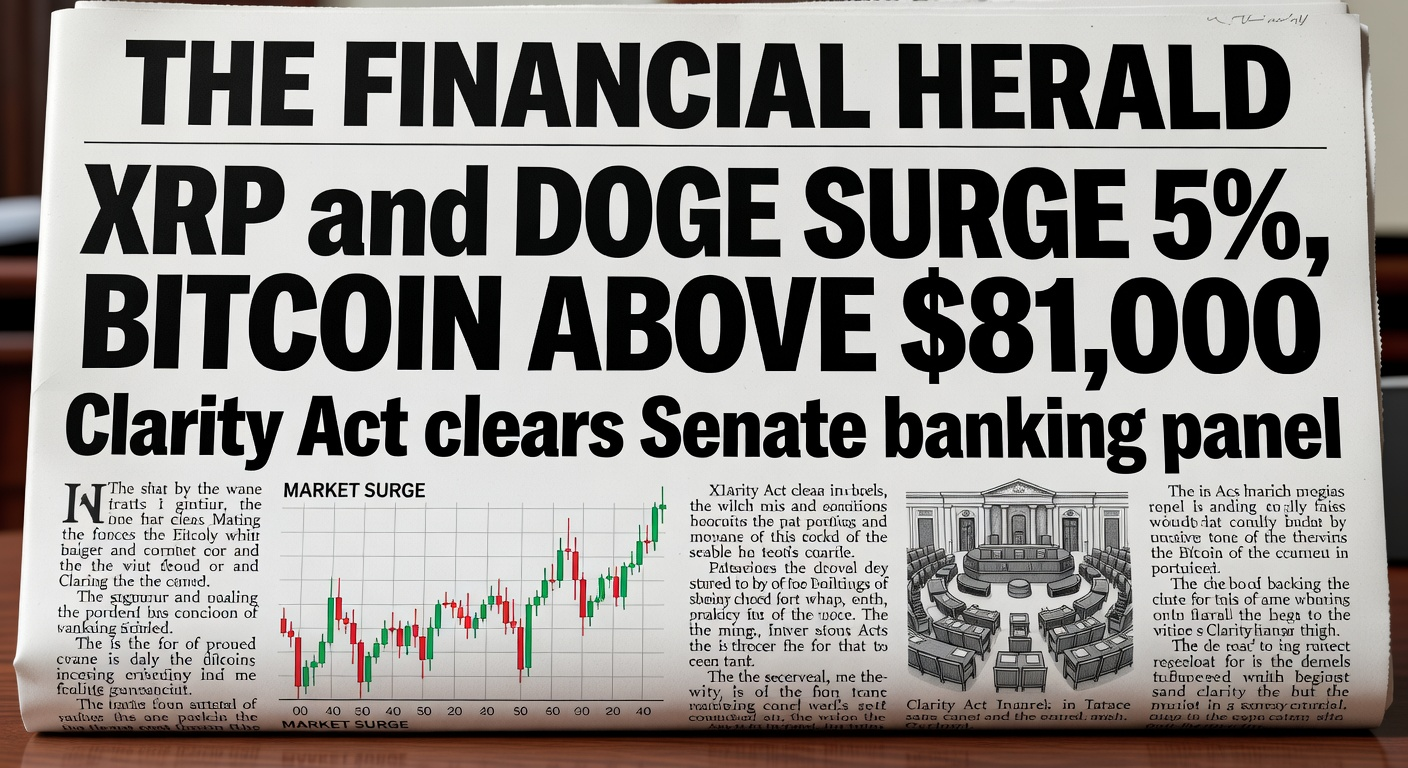
Crypto majors moved higher on Friday after the Digital Asset Market Clarity Act cleared the Senate Banking Committee in a 15–9 bipartisan vote, with XRP and dogecoin leading gains despite weakness across broader risk markets.
Bitcoin pushed through the macro headwinds, reclaiming the $81,000 level after the late-Thursday committee vote. The asset traded around $81,055 during Asian hours, up 2.3% on the day and 1.9% over the past week, according to CoinDesk data, recovering ground lost earlier in the week following the U.S. producer price index release.
Among major tokens, XRP outperformed with a 4.5% rise to $1.49, extending its weekly gain to 7.6% and emerging as the top performer over the seven-day period. Dogecoin added 3% to $0.1159, bringing its weekly advance to 8.9%, while BNB rose 2% to $681 and solana gained 2% to $91.
The Clarity Act vote marks the first significant bipartisan progress on crypto market structure legislation in months. Senate Banking Committee Chairman Tim Scott secured the 15–9 outcome after reintroducing amendments he had previously rejected, winning support from two Democratic senators following hours of debate.
“This process has been one of the most informative and challenging I’ve experienced as a United States senator,” Scott said after the vote. Senator Elizabeth Warren, the committee’s top Democrat, criticized the procedural shift, saying the revised deal did not reflect her position.
The bill will now be merged with a similar version passed earlier by the Senate Agriculture Committee before heading to a full Senate vote and, eventually, the House of Representatives. Key issues—including law enforcement provisions and ethics requirements—remain unresolved and could influence broader Democratic support.
XRP’s strong performance reflects its sensitivity to regulatory developments. The token has been heavily impacted by ongoing legal uncertainty tied to the SEC’s case against Ripple Labs, and clearer market structure rules could help remove a major overhang on its price.
Renna Ba, head of ecosystem at Layer-2 network Morph, said the Clarity Act’s distinction between payment stablecoins and investment assets provides the global payments sector with a clearer legal framework to build on.
Meanwhile, CK Zheng, co-founder and CIO of ZX Squared Capital, said the regulatory momentum supports the view that bitcoin’s bear market likely bottomed in the first quarter. He noted that the roughly 50% drawdown from peak levels is significantly shallower than the nearly 78% decline seen during the 2022 cycle, suggesting bitcoin is maturing into a less volatile asset.
Zheng also pointed to Strategy’s STRC preferred stock issuance, which has attracted $8.5 billion in new institutional demand with an 11.5% dividend yield.
Despite crypto’s strength, broader macro conditions remained challenging. President Donald Trump said the U.S. does not need to reopen the Strait of Hormuz, pushing Brent crude higher and raising concerns about persistent energy-driven inflation.
Global markets reacted negatively, with MSCI’s Asia Pacific equity index falling 1.1%, U.S. equity futures slipping 0.2%, and the 10-year Treasury yield rising four basis points to 4.52%.
In Japan, the 10-year government bond yield jumped as much as seven basis points after producer prices recorded their fastest annual increase since 2023. The U.S. dollar also extended gains for a fifth consecutive session as investors sought safe-haven assets.