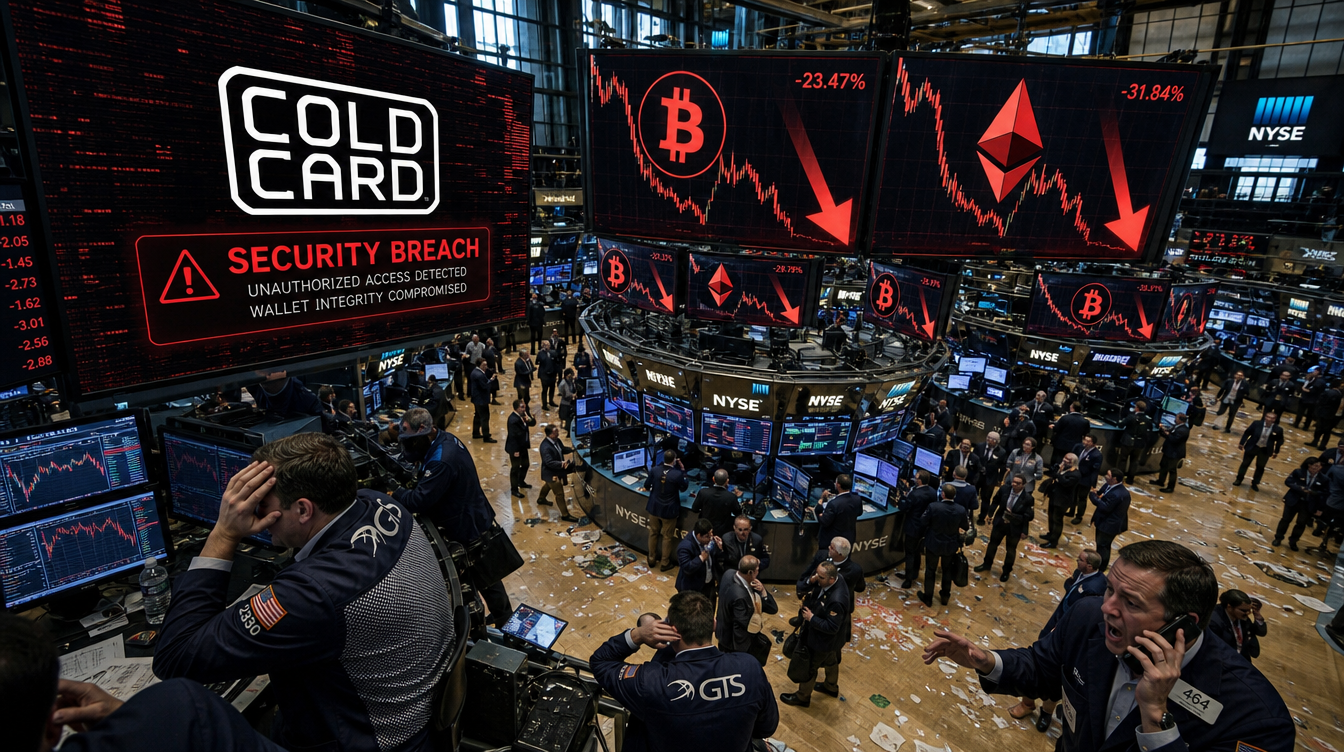
The crypto market’s decline has remained relatively limited despite the severity of the Coldcard wallet exploit, the significant bitcoin losses involved, and the damage it has caused to confidence in hardware-based self-custody.
Bitcoin (BTC) and ether (ETH) remain under pressure as the Coldcard hardware wallet breach reaches its fifth consecutive day, raising renewed concerns about whether direct asset ownership remains a reliable long-term strategy for crypto investors.
The attack has unsettled the crypto community, with many smaller holders reporting losses of coins accumulated over years and questioning the security of self-custody methods.
Marex analysts said the incident has negatively affected sentiment by encouraging some investors to move their holdings back onto centralized exchanges, reversing the broader industry trend toward personal custody. They added that lower prices may not be enough to restore confidence when concerns are focused on the safety of cold storage itself.
Despite the seriousness of the breach and the estimated $114 million in stolen bitcoin, the market reaction has been relatively restrained. Bitcoin recently traded down 1.5% over the previous 24 hours at around $62,595, a level it has tested multiple times in recent weeks. Ether declined nearly 2% to $1,842, while the CoinDesk DeFi Select Index fell 2.5%.
Bitcoin’s 200-week simple moving average, currently sitting above $63,000, has become a key level for traders after Strategy, the company led by Michael Saylor, announced it is monitoring the indicator. The firm also hinted that it could restart bitcoin accumulation following a five-week buying pause, its longest break so far, with funding supported by preferred stock issued at a 12% yield.
Market attention is also focused on uncertain geopolitical developments. President Donald Trump said new talks with Iran would begin, but Iranian officials quickly disputed the statement. Foreign Ministry spokesperson Esmaeil Baghaei said Tehran was not planning to receive a U.S. delegation or send its own representatives for negotiations.
Futures and Options Positioning
Bearish futures sentiment increases:
Crypto futures taker activity has shifted more negative compared with last week, with short positions making up more than 52% of trading volume. Market takers are participants who execute trades immediately against existing liquidity on exchanges.
Bitcoin futures open interest climbs:
Bitcoin futures open interest has risen to a one-month high of 772,000 BTC, showing increased market participation. Funding rates remain slightly positive at around 4% annually, suggesting a modest bullish bias. However, a slightly negative 24-hour cumulative volume delta indicates that sellers are being more aggressive through market orders.
Altcoin positioning remains uneven:
ADA, ETH, and BCH have seen notable increases in open interest, while SOL futures positions continue to decline. TRX, DOGE, CC, and GRAM are showing negative funding rates, reflecting increased demand for short positions. Still, funding levels are not extreme, suggesting bearish positioning has not become overly crowded.
Options market shows limited stress:
Even with the Coldcard exploit and rising Treasury yields, crypto options markets have remained stable. The BVIV 30-day implied volatility index has hovered near 37% for four consecutive days, indicating traders are not pricing in significant additional uncertainty.
Call options attract traders:
Deribit data shows that $68,000 and $70,000 bitcoin call options are among the most actively traded contracts, pointing to continued interest in potential upside moves.
Token Market Update
NEAR Protocol’s Intents platform has exceeded $24 billion in total transaction volume, according to the project’s latest monthly development update. The system allows users to define their desired transaction outcome, such as exchanging assets across multiple blockchains, while the network handles the underlying execution process.
The growth followed the launch of protocol version 2.13, which introduced major improvements including quantum-resistant signing and dynamic resharding. Quantum-resistant security upgrades aim to protect transactions against future quantum computing risks, while dynamic resharding enables the network to automatically distribute workloads as activity expands.
NEAR is also strengthening its artificial intelligence strategy by introducing AI compute staking, allowing token holders to lock NEAR tokens to support AI infrastructure and earn rewards connected to computing demand.
NEAR recently traded around $1.72, according to CoinDesk data.