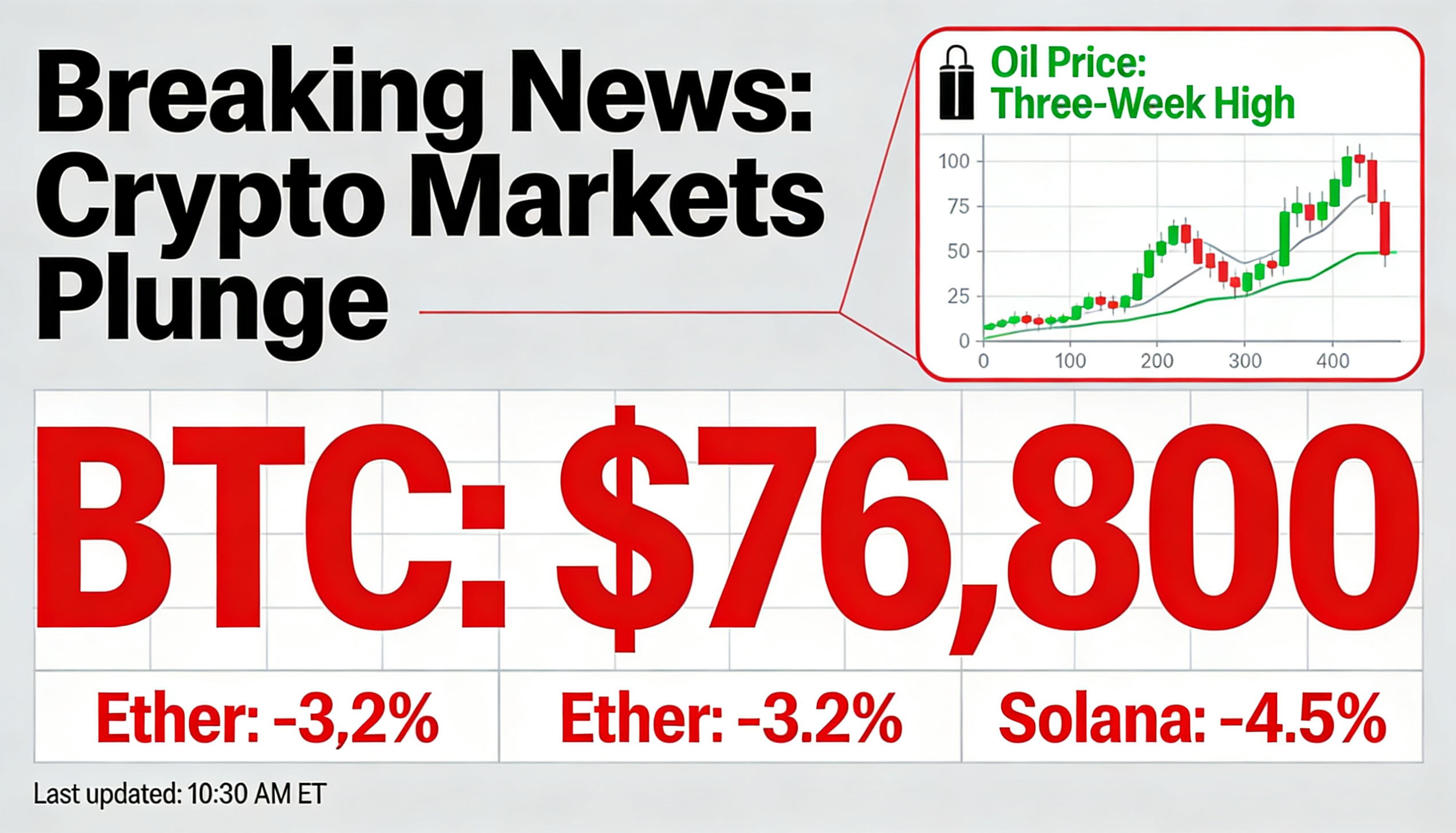
Bitcoin slipped to $76,923 on Tuesday morning, down 2.4% over the past 24 hours after failing to hold above $79,400 in the previous session. The rejection adds to a series of unsuccessful attempts to break $79,000, with the level now emerging as a key short-term ceiling.
Bitcoin’s price briefly reached $79,399 on Monday before reversing intraday and extending losses into Tuesday. Ether dropped 3.7% to $2,290, XRP fell 3.2% to $1.39, solana declined 3.9% to $84.10, and BNB slipped 1.8% to $625. The broader top 10 crypto assets were mostly in the red over the 24-hour period, with only TRON and DOGE holding gains.
Macro conditions added pressure as Brent crude extended its rally for a seventh consecutive day, rising 1% to trade above $109 a barrel. The move follows stalled negotiations over Iran’s proposal to reopen the Strait of Hormuz, with U.S. officials signaling that key negotiating “red lines” remain unchanged. The ongoing geopolitical tension has kept energy markets elevated and added to inflation concerns.
Equity markets were mixed, with the MSCI Asia Pacific Index little changed. Japanese equities found support after the Bank of Japan voted 6–3 to keep policy unchanged, while the yen strengthened modestly to around 159 per dollar.
In crypto markets, analysts remain split on the underlying strength of the recent rally. Galaxy Digital CEO Mike Novogratz pointed to a return of U.S. retail participation alongside institutional inflows and constrained supply, arguing that conditions still support further upside. On-chain data from Santiment also shows whales accumulating more than 40,000 BTC over the past two weeks, alongside a rapid shift in sentiment from fear toward FOMO.
However, CryptoQuant founder Ki Young Ju offered a more cautious interpretation, saying the move above $79,000 was largely driven by a derivatives short squeeze rather than sustained spot demand. He warned that once forced short covering fades, the market could become vulnerable to reversal if fresh buying does not emerge.
Supporting that view, funding rates on perpetual futures remain negative on a 7-day basis at -0.13%, according to Coinglass. That suggests short positions are still dominant and paying longs—conditions that often accompany both squeeze-driven rallies and subsequent unwinds.
Still, spot accumulation continues at the corporate level. Strategy reportedly added $3.9 billion in bitcoin purchases in April, marking its largest monthly accumulation in a year. In Japan, Metaplanet announced a $50 million bond issuance to fund additional bitcoin acquisitions, extending its ongoing strategy of using debt to expand its treasury holdings.
Attention now turns to a critical macro week. The Federal Reserve announces its policy decision on Wednesday, with markets increasingly pricing in the possibility of easing. That follows the closure of a Justice Department probe into Fed Chair Jerome Powell, which has shifted rate-cut expectations.
Big Tech earnings will also be in focus, with Alphabet, Microsoft, Amazon, and Meta reporting on Wednesday, followed by Apple on Thursday. Together, the group represents roughly a quarter of the S&P 500’s market capitalization.
Traders say either a dovish Fed signal or strong tech earnings could provide the catalyst needed to push bitcoin above $80,000. Without such support, repeated rejections near $79,000 may begin to define the upper boundary of the current range.