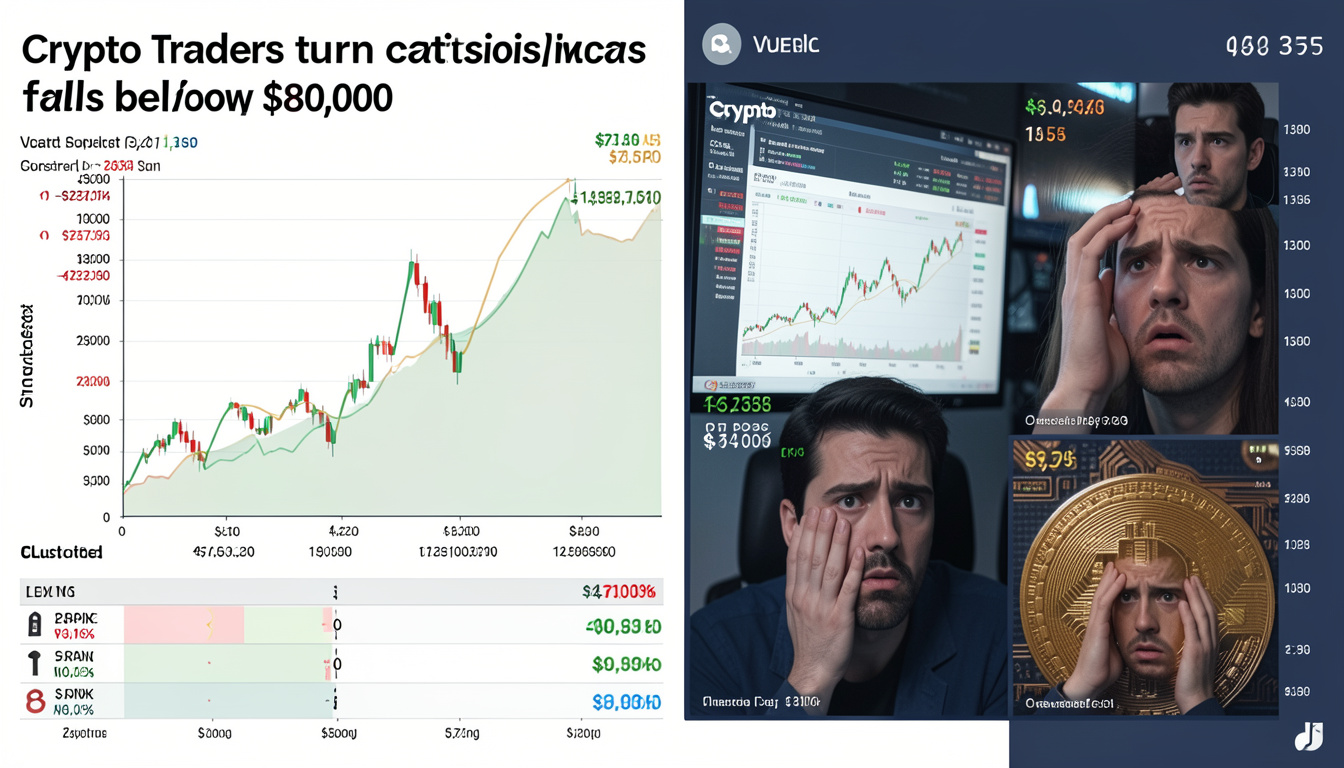
Bitcoin’s rally lost traction below the $80,000 mark, dragging ether lower and signaling a broader cooling in risk appetite as derivatives data and macro conditions point to a quieter, more cautious market phase.
The crypto market extended its pullback for a second straight day on Tuesday, with bitcoin hovering near $75,800 and ether slipping by a similar margin, each down roughly 0.75% since midnight UTC. The move follows two failed attempts by bitcoin to decisively clear the $80,000 resistance level over the past week, with the latest rejection occurring during Monday’s Asian trading session.
Momentum from last week’s surge—from $70,000 to nearly $79,500—is fading as key indicators begin to turn negative. Notably, the Coinbase Premium Index has flipped below zero, suggesting weakening demand from U.S.-based investors.
Broader financial markets are also leaning risk-off. Nasdaq 100 futures are down about 0.5%, while the U.S. dollar index has edged higher. Meanwhile, geopolitical uncertainty continues to weigh on sentiment, with stalled U.S.–Iran negotiations pushing Brent crude oil above $105 per barrel.
In derivatives markets, activity is cooling. Total crypto futures open interest has declined by more than 1% to $120 billion over the past 24 hours, alongside a 3% drop in trading volume and an 8% reduction in liquidations. The combination points to reduced participation and less aggressive positioning across the market.
Bitcoin-specific metrics reinforce the cautious tone. The options-to-futures open interest ratio has slipped to 57.5%, its lowest level since late January, indicating a shift toward directional bets and expectations of short-term volatility. Futures open interest has also fallen sharply, down over 9% from recent highs, while funding rates remain negative—though largely driven by institutional hedging rather than outright bearish sentiment.
One notable exception is dogecoin, where open interest has risen 6% in the past day to its highest level since October. Positive funding rates and strong volume trends suggest traders are positioning for potential upside.
Elsewhere, solana and cardano are showing signs of sustained selling pressure, with deeply negative cumulative volume deltas indicating aggressive sell-side activity.
Despite the recent price weakness, volatility expectations remain subdued. Bitcoin and ether’s 30-day implied volatility indices are near three-month lows, reflecting muted risk pricing amid ongoing macro uncertainty. Options markets further highlight a defensive tilt, with puts trading at a premium for both assets—especially bitcoin—hinting at cautious sentiment, even as some traders position for relative strength in ether.
Flow data shows heavy activity around the $80,000 bitcoin strike, which remains the most traded level in both volume and open interest. Structured trades such as risk reversals and put spreads in bitcoin, along with straddles in ether, underscore the market’s hedging focus.
Altcoins underperformed bitcoin during the session, with memecoins and DeFi tokens posting steeper losses. Privacy token zcash led declines among major altcoins, while chiliz and hyperliquid also saw notable drops.
Still, there were pockets of strength. Apecoin surged more than 17%, driven by a short squeeze that saw roughly $1 million in bearish positions liquidated.
Overall, the market remains in a holding pattern. CoinMarketCap’s Altcoin Season Index sits at a neutral 39, reflecting a lack of clear leadership beyond bitcoin. For now, attention is firmly fixed on whether bitcoin can reclaim $80,000—or drift further toward the mid-$70,000 range.