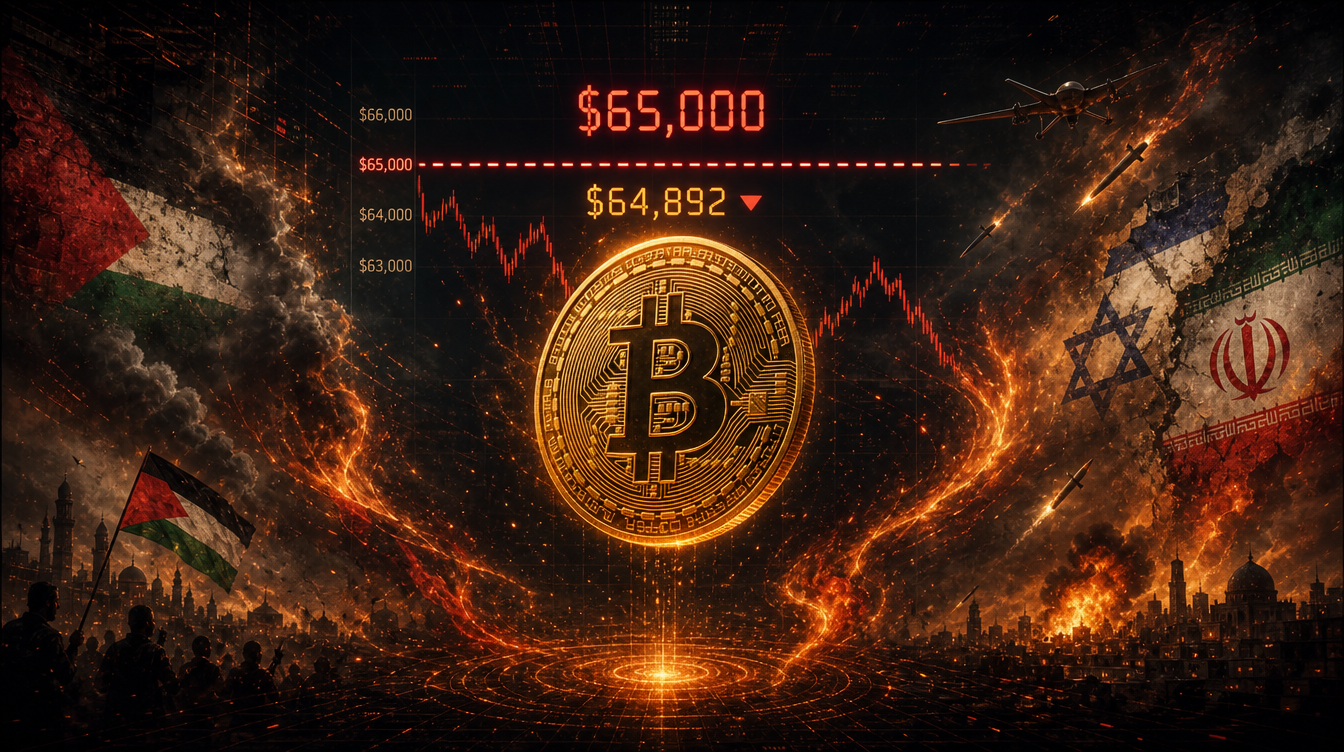
Bitcoin continued trading below $65,000 on Friday as investors weighed renewed Middle East tensions, rising crude prices, and uncertainty ahead of key U.S. economic data.
BTC hovered near $64,700, showing minimal movement over the previous 24 hours, while the broader CoinDesk 20 (CD20) index slipped 0.2% during the same period.
Brent crude moved above $83 per barrel after Yemen-based Houthi militants linked to Iran launched an attack on Saudi Arabia, further escalating geopolitical concerns in the region.
U.S. Treasury yields saw a modest pullback but remained elevated, with the 10-year note holding around 4.67%. Fidelity’s global macro director Jurrien Timmer previously noted that historical trends suggest markets often face difficulties when 10-year yields remain above 4.5%.
Persistent strength in oil prices could increase inflationary pressures, while high Treasury yields may continue to restrict financial conditions. Together, these factors could weaken expectations for imminent Federal Reserve rate cuts and create headwinds for Bitcoin and other risk assets.
Gold continued its upward move as investors sought safety amid uncertainty, climbing 1.5% to reach around $4,300 per ounce.
Crypto Derivatives Market
Futures sentiment cools:
The crypto futures market’s long-short taker ratio returned to a neutral level after leaning bullish on Thursday, indicating traders are becoming more cautious ahead of the U.S. payrolls report.
CC token faces selling pressure:
Canton Network’s CC token fell 13% over the past 24 hours, even as futures open interest increased by more than 5%. The combination suggests bearish momentum may be strengthening, with negative open-interest-adjusted cumulative volume delta (CVD) indicating that sellers are actively opening short positions through market orders.
Open interest trends:
DOGE, XRP, and SUI saw increases in open interest, while SHIB recorded a decline.
Market momentum remains weak:
The CVD indicator continues to show bearish conditions, with most major cryptocurrencies posting negative readings. ADA, HBAR, and ETH were among the few assets showing positive signals.
Volatility stays muted:
Bitcoin’s BVIV index, which tracks 30-day implied volatility, remains near its established floor around 36%. Despite uncertainty around the delayed Clarity Act and the upcoming U.S. jobs report, traders have not priced in a major volatility event. Ether’s EVIV index has followed a similar pattern.
Options traders position defensively:
On Deribit, BTC put options at the $60,000 and $62,000 strike levels dominated 24-hour trading activity, reflecting demand for downside protection. For ETH, the $2,000 call option was the most actively traded contract.
Token Developments
Sui introduces quantum-resistant wallet protection
Sui has added quantum-resistant security features to its accounts by integrating two post-quantum signature algorithms approved by the U.S. National Institute of Standards and Technology (NIST), according to The Block.
The upgrade allows users to activate quantum-safe keys derived from their existing recovery phrases, enabling stronger protection without requiring new seed phrases or wallet migrations.
The feature is designed to defend against a blockchain-specific threat known as “harvest-now, forge-later” attacks. In traditional systems, attackers generally need to compromise a key before exploiting it. On blockchains, however, public keys can become visible once users transact, allowing attackers to collect exposed keys and potentially break them later when quantum computers become advanced enough to execute Shor’s algorithm.
Sui is implementing two separate cryptographic solutions for different security needs. ML-DSA-65 is intended for regular user accounts at the protocol level, while SLH-DSA-SHA2-128s, a hash-based signature scheme, is being used within Move smart contracts for high-value applications. The use of different algorithms provides additional protection by avoiding reliance on a single cryptographic method.
The upgrade follows a July incident in which an AI model reduced the effective security strength of another post-quantum cryptography candidate, highlighting the importance of maintaining additional security safeguards.
Sui said the feature is part of its “cryptographic agility” approach, allowing future encryption methods to be introduced without changing consensus rules or impacting existing balances.
The development contrasts with Bitcoin and Ethereum, where implementing quantum-resistant protections would likely require more complex upgrades. It also arrives as major Bitcoin industry players, including Strategy and BlackRock, explore preparations for potential quantum computing threats.
SUI was trading around [X], according to CoinDesk data.