MARA Holdings is still mining bitcoin, but its latest results suggest the business is increasingly evolving beyond pure crypto production.
In its first-quarter update, the company made clear that while bitcoin remains central to operations, future growth will rely less on expanding mining capacity and more on building out power, data center, and AI infrastructure. Notably, MARA signaled it does not plan significant new purchases of ASIC mining machines—historically a key indicator of expansion in mining activity.
Instead, the firm is prioritizing a flexible power strategy that can support both bitcoin mining and high-performance computing. By colocating new infrastructure with existing mining operations, MARA aims to generate steady bitcoin revenue while retaining the ability to redirect energy toward AI and critical IT workloads as demand increases. The company said as much as 90% of its non-hosted mining capacity could eventually be repurposed for AI and related uses.
Financially, the quarter reflected both operational progress and market pressure. Revenue fell 18% year-over-year to $174.6 million, while net losses widened sharply to $1.3 billion, largely due to unrealized losses on its bitcoin holdings, which totaled 38,689 BTC. The decline comes as bitcoin prices dropped roughly 17% over the same period.
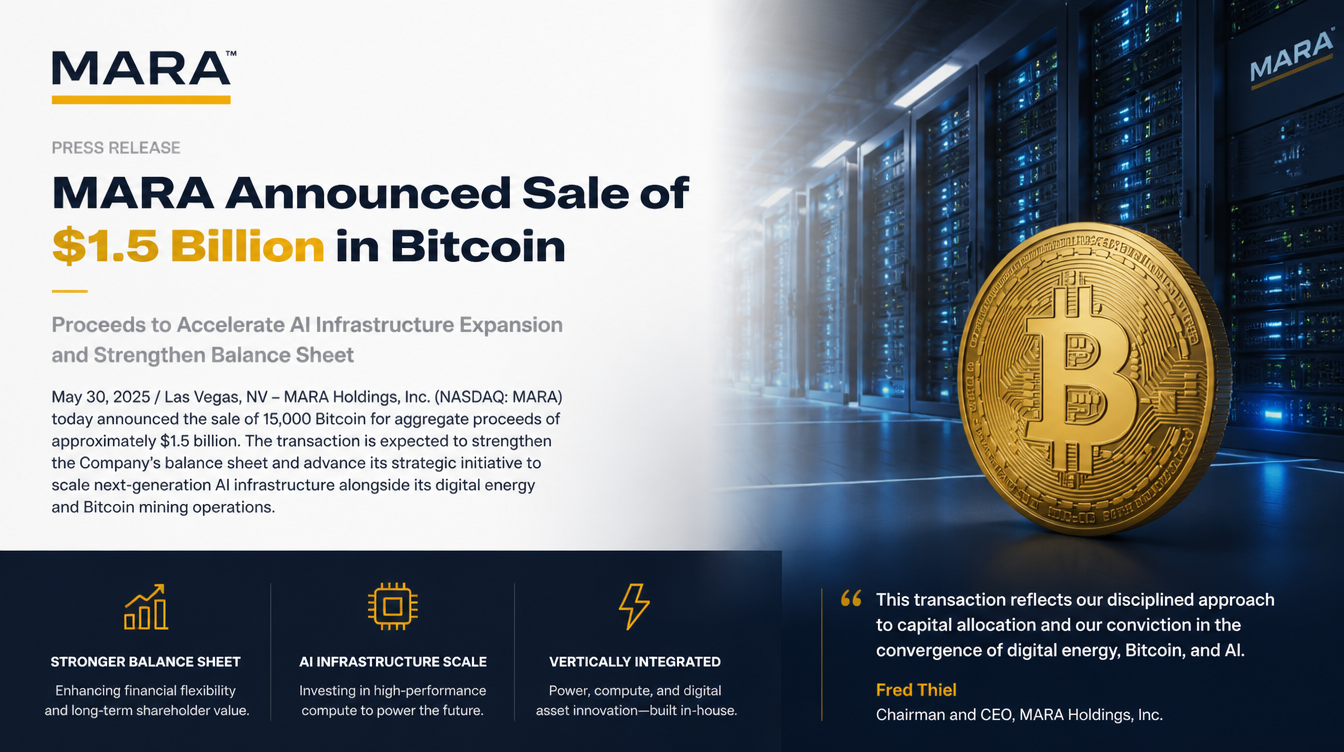
To strengthen its balance sheet, MARA sold $1.5 billion worth of bitcoin during the quarter, including a $1.1 billion sale near the end of the period to fund the repurchase of convertible notes. The move reduced its standing among public companies holding bitcoin, with MARA slipping to the fourth-largest holder, according to Bitcoin Treasuries data cited in its filing.
The shift highlights a broader change in strategy. While miners were once valued largely on how much bitcoin they could accumulate, MARA is increasingly treating its holdings as a financial resource—deploying them when needed to manage liquidity and debt.
That transition is also evident in its recent deals. MARA has partnered with Starwood Capital and agreed to acquire Long Ridge Energy & Power, a gas-fired power plant and data center site in Ohio, in a $1.5 billion deal. The company said the facility could ultimately support more than 600 megawatts of AI computing capacity.
Despite the strategic pivot, mining activity did grow during the quarter. Energized hashrate rose 33% year-over-year to 72.2 exahash per second, and the company produced 2,247 bitcoin, up from 2,011 in the previous quarter.
Even so, while bitcoin mining remains an important part of MARA’s operations, it is no longer clear that it sits at the center of the company’s long-term strategy.