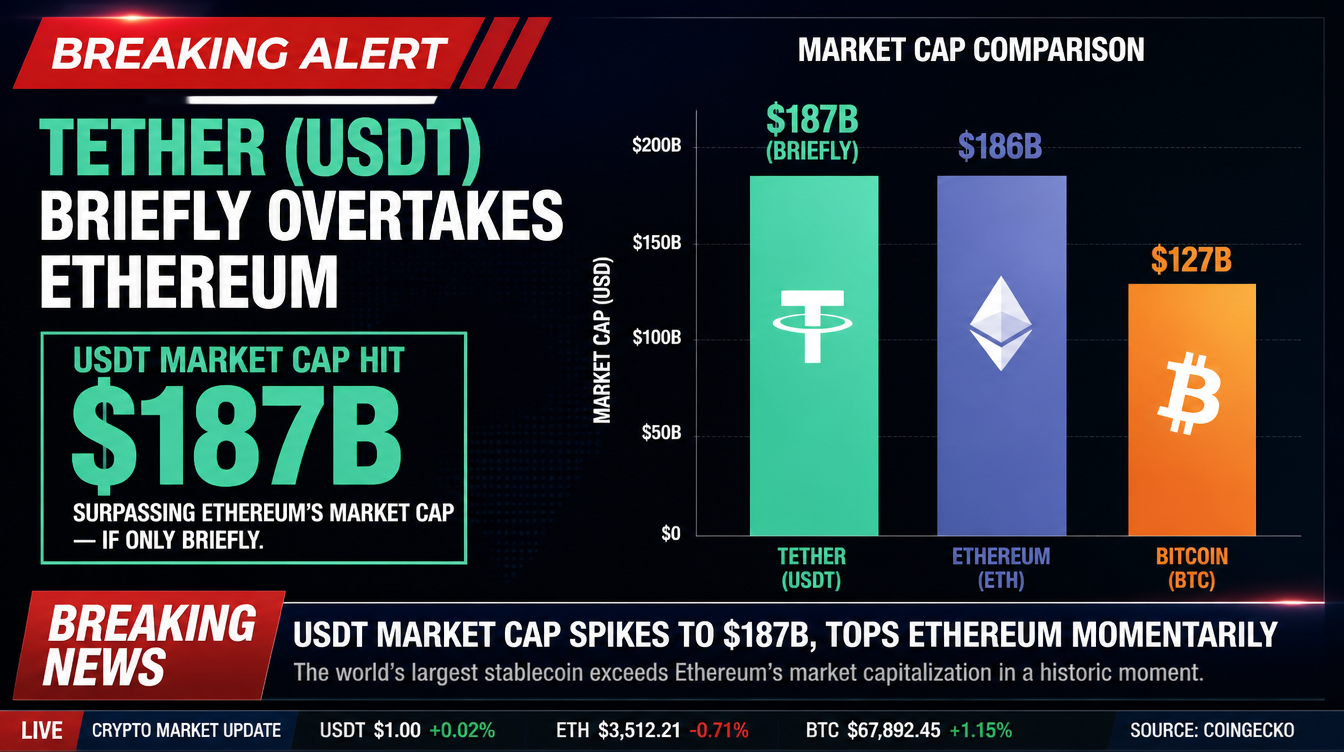
Tether’s USDT briefly surpassed Ethereum in market capitalization earlier this week, marking the first such occurrence in eight years. During the crossover window, multiple data sources showed both assets clustered between $183 billion and $188 billion, with one snapshot placing USDT at $187 billion and ETH just behind at $186 billion.
The flip lasted only a few hours, with Ethereum reclaiming second place once price action stabilized. Still, the underlying drivers—consistent USDT supply growth and persistent ETH price pressure—remain intact.
Market Structure: Issuance vs Price Weakness
The shift was not caused by changes in Ethereum’s supply, but rather by declining price. In contrast, USDT’s market cap expanded through continued issuance. Tether’s Q4 2025 attestation showed supply hitting a record $187.3 billion, reflecting a $12.4 billion increase in a single quarter despite broader market weakness.
Over a 12-month period, USDT grew from $144.2 billion to $184 billion, a 28% rise, while Ethereum’s valuation moved in the opposite direction.
Leading into the crossover, more than $7 billion exited the stablecoin sector, while total crypto market capitalization dropped by roughly $400 billion. Ethereum’s DeFi total value locked (TVL) declined to approximately $36 billion. Rather than abandoning stablecoins, market participants appeared to be rotating into them as a defensive strategy, reducing exposure to volatility.
USDT now represents about 59% of the stablecoin market, with USDT and USDC together accounting for roughly 82%, reinforcing Tether’s central role in liquidity flows.
The Bigger Picture: A Continuing Trend?
Bloomberg Intelligence strategist Mike McGlone has long pointed to this trajectory. In October 2020, when USDT stood at $16 billion versus Ethereum’s $43 billion, he suggested Tether was on track to close the gap within a year, calling it part of a broader structural shift toward stablecoins.
His latest outlook extends that thesis further, suggesting the “flippening” could continue. McGlone has indicated USDT may surpass Ethereum again in 2026—and potentially even challenge Bitcoin under more extreme scenarios. In one such case, a sharp Bitcoin decline toward $10,000 combined with significant USDT growth could reshape the top rankings.
While that scenario remains speculative, past skepticism toward USDT’s rise proved misplaced.
ETH vs USDT: A Narrow Lead
Ethereum has since regained its position as the second-largest asset, but the margin remains thin. Sustained price strength would be required to solidify its lead, or alternatively, a slowdown in USDT issuance.
Neither outcome is certain. Ethereum’s long-term outlook is supported by ongoing technical advancements, including progress in zero-knowledge scaling, but these catalysts operate on a longer timeline than current market pressures.
Meanwhile, USDT’s expansion shows no signs of slowing. With its $1 peg, its market cap directly reflects circulating supply, meaning every new token minted translates immediately into higher valuation—without exposure to price volatility.
As a result, the dynamics that briefly pushed USDT ahead of Ethereum remain firmly in place, even if the ranking has since reverted.