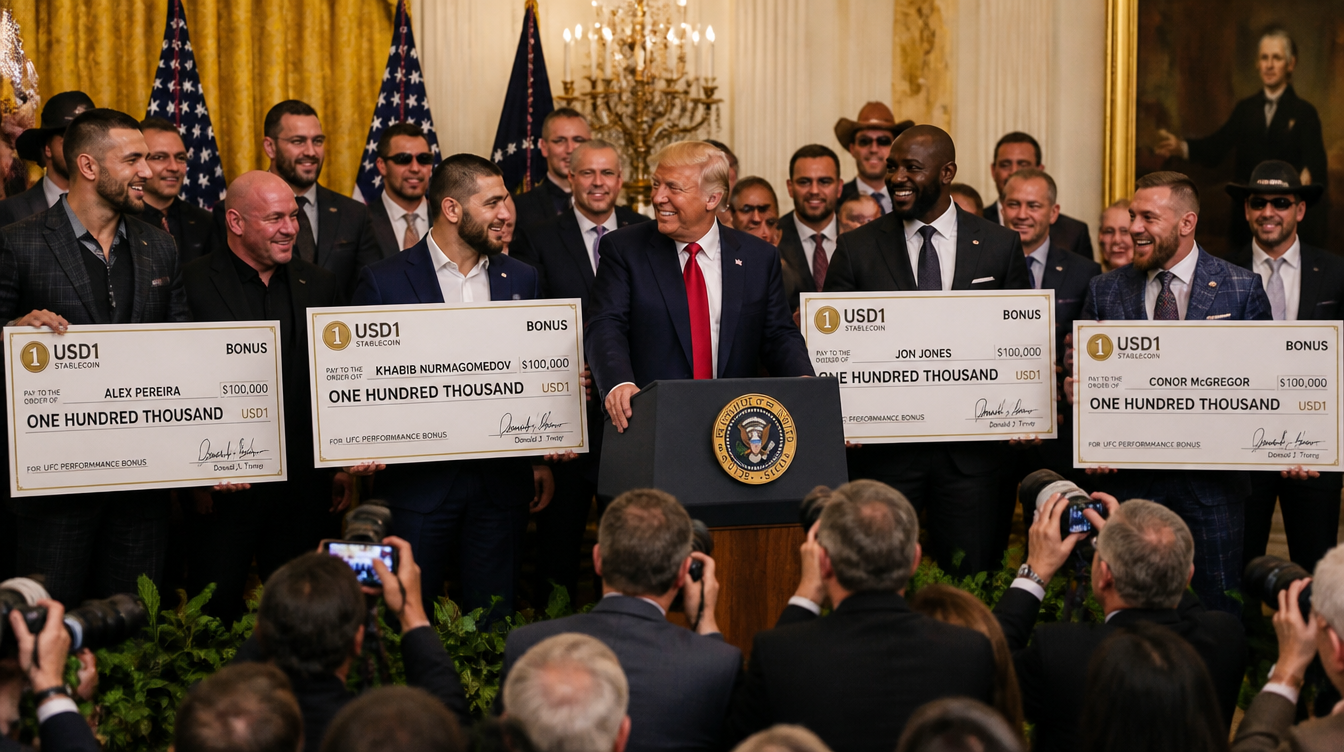
World Liberty Financial utilized its USD1 stablecoin to distribute $250,000 in fighter bonuses at UFC Freedom 250, a mixed martial arts event hosted on the White House South Lawn on June 14 in celebration of President Trump’s 80th birthday.
As the event’s presenting partner, WLFI issued USD1 rewards across seven bouts, marking the most prominent real-world showcase of the Trump-linked stablecoin so far.
The rollout coincided with a broader crypto push. WLFI tokens gained 3% following the sponsorship announcement, while Binance launched a rewards campaign distributing 178 million WLFI governance tokens to USD1 holders. Crypto.com also contributed a separate $1 million bonus pool denominated in CRO as co-presenter. Combined, total crypto-based fighter bonuses approached $1.65 million.
Breaking Down the USD1 Bonus Structure
WLFI allocated a $250,000 performance pool in USD1, awarded to fighters across seven matches based on standard UFC bonus criteria.
The payouts were made in USD1, a dollar-pegged stablecoin backed by cash reserves and short-term U.S. Treasuries custodied with BitGo. In effect, fighters received compensation equivalent to U.S. dollars, but in a digital format tied to a Trump-affiliated DeFi platform.
Todd Phillips of Klaros Group noted that while the payments function similarly to traditional cash payouts, branding them in USD1 serves as a marketing strategy—promoting the stablecoin’s association with both the UFC and the White House.
White House Venue and Conflict Concerns
The event underscores the longstanding overlap between Trump’s political identity and commercial ventures, particularly in crypto. Hosting a UFC card at the White House while distributing bonuses through a family-linked stablecoin highlights that convergence.
The administration maintains that Trump’s assets are held in a trust managed by his children. However, reports indicate the Trump family receives approximately 75% of net proceeds from WLFI token sales, along with a share of returns generated from USD1 reserves.
The use of a taxpayer-funded venue, alongside ongoing regulatory developments affecting stablecoins under an administration tied to a private issuer, has raised questions about potential conflicts of interest.
The SEC has also issued an investor bulletin identifying USD1 as a privately issued stablecoin linked to the president’s family.
Market Implications and Risk Outlook
From a marketing perspective, the strategy is effective. A White House-hosted UFC event delivers significant visibility, positioning USD1 in front of a global audience.
However, risks remain. USD1 has reportedly pushed liquidity pool utilization to as high as 93% to support internal borrowing, is engaged in a legal dispute with Justin Sun over frozen assets, and is pursuing a federal banking charter.
For DeFi participants, USD1 is more than a stablecoin—it operates within a complex intersection of political influence, financial incentives, and evolving regulation.