Removing the QQQ-linked token QQQB from the equation, July’s tokenized equity volume would fall to დაახლოებით $2.03 billion—about 30% below June’s estimated $2.91 billion.
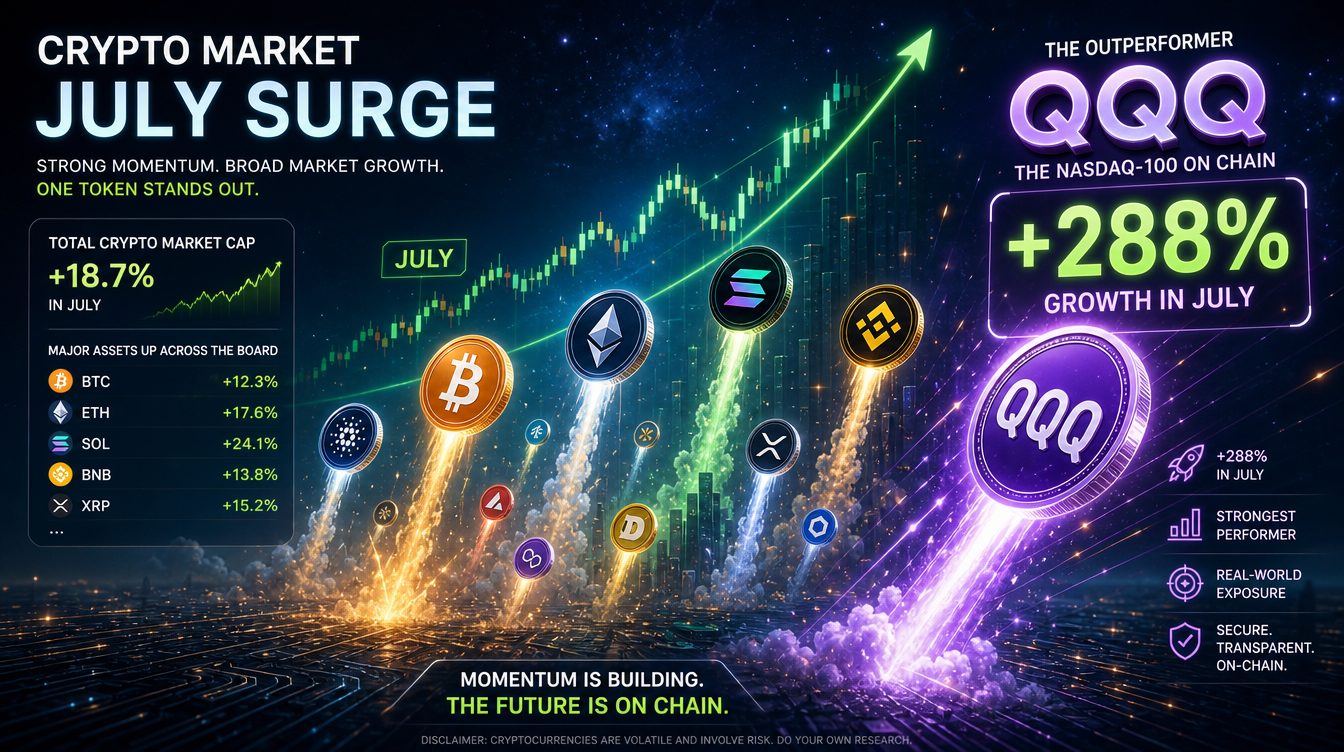
While total trading in tokenized stocks and ETFs surged 288% to a record $11.3 billion in July, the vast majority of that increase was driven by a single Binance-associated token.
Data from CoinDesk shows Binance’s bStocks contributed $9.41 billion, or 83.3% of total volume. QQQB alone—tracking the Invesco QQQ ETF—accounted for $9.27 billion, representing roughly 82% of all tokenized equity trading.
Excluding QQQB reveals a much softer market. xStocks volume dropped significantly to $335 million from $1.55 billion in June, while Ondo posted $792 million and Backpack recorded $479 million.
QQQB started trading on Binance on June 30, offering zero maker fees through Aug. 31. On July 23, Binance also introduced a 3x volume multiplier for stock and bStocks trades for certain users seeking VIP status, though this adjustment did not impact actual trading figures.
Meanwhile, the Invesco QQQ Trust declined 6.6% over the month, compared with a 3.2% drop in the Nasdaq Composite and a slight 0.1% dip in the S&P 500. The ETF fell as much as 10.2% from its June 30 level before recovering late in the month.
Market swings were largely driven by AI and semiconductor stocks. The iShares Semiconductor ETF slid 22.1%, its worst performance since December 2002, while Micron shares dropped 28.7%, according to MarketWatch. Increased volatility tied to AI-driven trading, the FOMC meeting, and major tech earnings helped boost activity in QQQ.
One of the main advantages of tokenized equities is their round-the-clock trading. By mirroring traditional stocks on blockchain infrastructure, they enable continuous access, allowing global investors to trade outside U.S. market hours and in markets where direct brokerage access is limited.